
Prosecco di Valdobbiadene.
The leading global Italian sparkling wine, history and pairing.
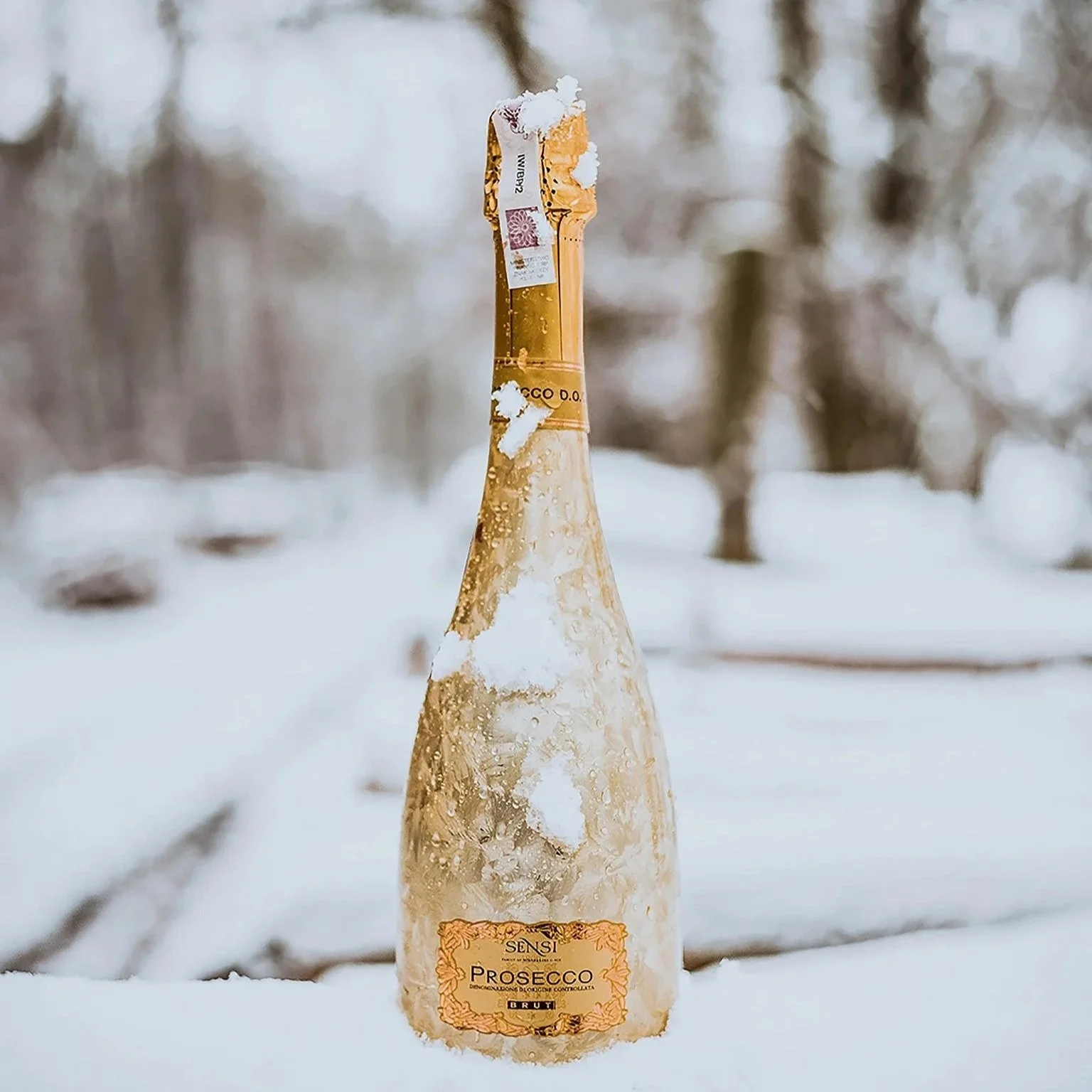
Valdobbiadene
"Quo Vineta Vernatur, Sub Monte Jugo Calvo, Quo Viror Umbrosus Tegit Sicca Metalla" (“an area where vines bud below the high mountains, and in which the lush greenery protects the more barren zones”)
Prosecco is confirmed as the best-selling Italian sparkling wine in the world, with a historic record of approximately 667 million bottles in 2025, exported to 164 countries and worth over €3.6 billion. As the leading global sparkling wine, Prosecco owes its success to its excellent value for money, versatility and popularity in markets.
Vine-growing has been widespread in the Conegliano Valdobbiadene zone since ancient times. A memorial stone in the area recalls the words of a Roman centurion, mentioning the vendemmiales, celebrations on the occasion of the grape harvest.
VI Century
San Venanzio Fortunato, Bishop of Poitiers (530-607 A.D.), describes Valdobbiadene, his place of origin, thus: "Quo Vineta Vernatur, Sub Monte Jugo Calvo, Quo Viror Umbrosus Tegit Sicca Metalla" (“an area where vines bud below the high mountains, and in which the lush greenery protects the more barren zones”)
XII Century
A 12th century fresco on the external façade of the parish church of San Pietro di Feletto portrays the “Sunday Christ”. The warning is clear: those who work on Sundays make Christ suffer (we see him bleeding, surrounded by tools for work). Thank to these we can understand what were the typical jobs in these hills at that time, and how vines and wine were already part of everyday life.
1574
In 1574, when King Henry III of Poland passed through on his way to Paris to be crowned King of France, the community of Conegliano made the white wine from its hills pour all day from the Fountain of Neptune.
1754
In 1754, Aureliano Acanti in his “Il Roccolo, Ditirambo” cites "Prosecco". It is the first written mention of the name.
1772
Francesco Maria Malvolti (1725-1807), in Volume VIII of the Giornale d’Italia of 1772, links Prosecco for the first time with Conegliano Valdobbiadene.
1868
Count Marco Giulio Balbi Valier, famous for identifying and selecting a type of Prosecco vine that was better than the others and known as “Prosecco Balbi”, published a booklet in 1868 in which he described his own crops.
1876
In 1876, Conegliano’s School of Winemaking was founded, the first of its kind in Italy.
1923
In 1923, the foundation of the Experimental Station for Viticulture and Oenology took place in Conegliano. (Treviso)
1930s
In the 1930s the boundaries of the production area for Prosecco were outlined
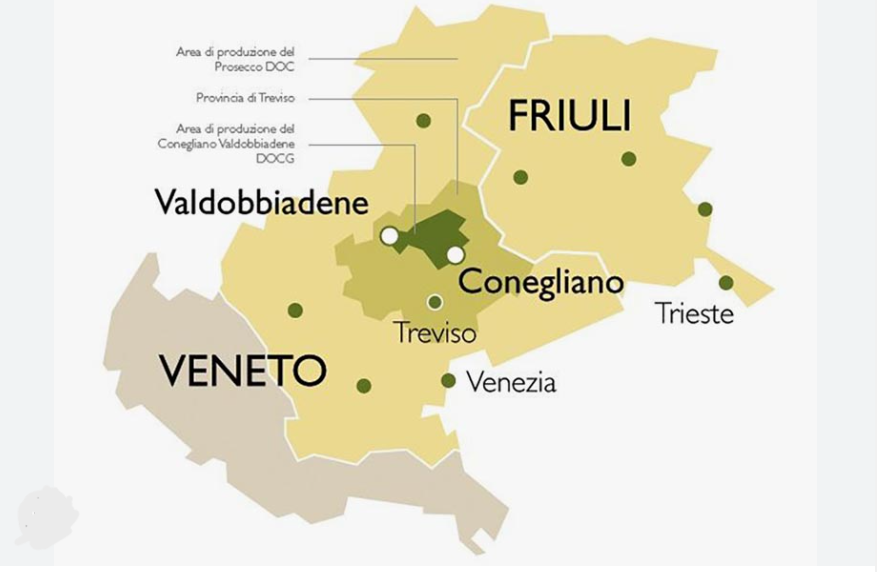
The wine region, Veneto
The bounderies of the prosecco production are in the north eastern part of Italy, at the foot of the Alps (Dolomites) and not far from the coast of the Adriatic Sea. (click here for more)
1946
In 1946 the Brotherhood of Prosecco was founded. (Consorzio del Prosecco)
7th June 1962
11 producers formed the Consorzio di Tutela del Prosecco di Conegliano e Valdobbiadene (Consortium for the Protection of Prosecco from Conegliano and Valdobbiadene)
1963
The first Sparkling Wine Exhibition was inaugurated in Valdobbiadene.
1966
The Strada del Prosecco was set up, the first recognized Wine Road in Italy.
2nd April 1969
Denominazione di Origine Controllata status was granted to the Prosecco produced in the 15 communes between Conegliano and Valdobbiadene.
1960s and ’70s
An important contribution to improving the quality of production was given by Prof. Tullio De Rosa, author of important texts such as Tecnologia dei Vini Spumanti, a work of reference in perfecting the Conegliano Valdobbiadene method of making sparkling wines, studied by generations of students.
2003
The Denomination was awarded the status of First Sparkling Wine District in Italy.
2004
The District’s Research Centre was founded. The results of the studies carried out by this body are presented every year in December.
1st August 2009
Conegliano Valdobbiadene became Italy’s 44th D.O.C.G. (Denominazione di Origine Controllata e Garantita)
Types of wine (Sparkling)
DOCG
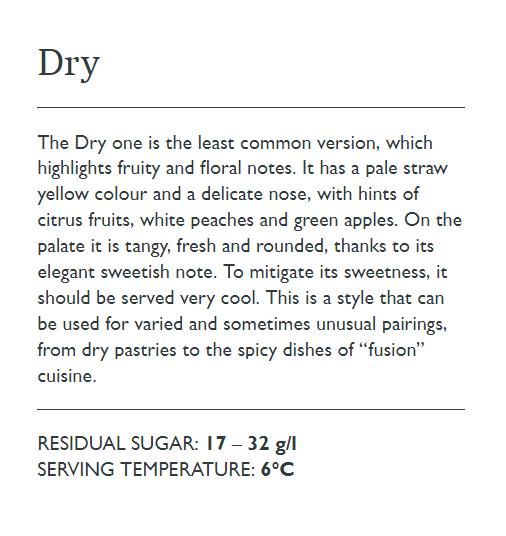
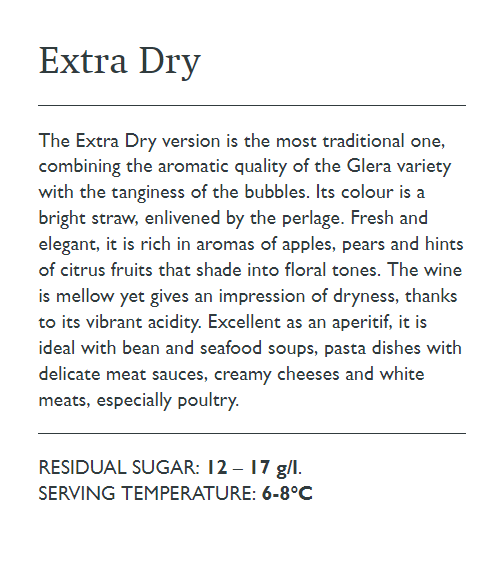
Conegliano Valdobbiadene Prosecco Superiore is a D.O.C.G. sparkling wine produced exclusively in the hills of the Conegliano Valdobbiadene zone, from the Glera grape variety, grown in a denomination made up of 15 communes (municipal areas). The permitted grape yield in the vineyards is 13.5 tonnes per hectare. Each winery, by skilfully mixing the grapes from the various micro-zones of the area, creates the blends (“cuvées”) that act as ambassadors for its own, distinctive winemaking philosophy. Conegliano Valdobbiadene Prosecco Superiore may be enjoyed in Extra Brut, Brut, Extra Dry and Dry versions, classified according to their level of residual sugar.
DOCG Rive
The term “Rive” indicates, in the local way of speaking, the slopes of the steep hills that are characteristic of the zone. This category of wine highlights the diverse expressions of Conegliano Valdobbiadene. Rive wines are often obtained from the most precipitous, high-quality vineyards, from grapes grown in a single commune or area thereof, thus underlining the characteristics that a particular terroir gives to the wine. Within the denomination there are 43 Rive, and each one expresses a different and distinctive combination of soil, exposure and microclimate. In the Rive, yields are reduced to 13 tonnes of grapes per hectare, the grapes are picked exclusively by hand and the vintage is always shown on the label.
DOCG Cartizze
Absolute top quality within the denomination, Superiore di Cartizze comes from a sub-zone that has had its own specific regulations since 1969. It covers just 107 hectares of vineyards, lying amidst the steepest hillsides of San Pietro di Barbozza, Santo Stefano and Saccol, in Valdobbiadene. The perfect combination of a mild microclimate and ancient soils, made up of moraines, sandstone and clays, give these wines unique characteristics. The maximum yield is of 12 tonnes of grapes per hectare. The nose is characterized by complex scents that recall apples and pears, citrus fruits, aromas of peaches and apricots and hints of roses, along with a note of almonds in the aftertaste. Its flavour is well-balanced and elegant, with very fresh, mellow fruit underpinned by delicate, fine bubbles.
DOCG Sui Lieviti
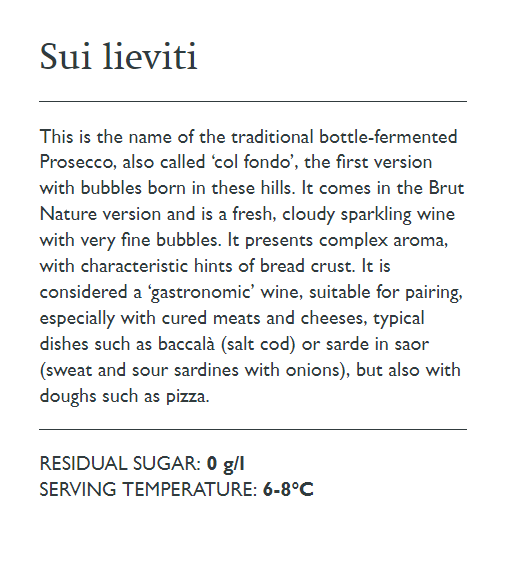
This is the name of the traditional Prosecco on the lees, with sediment in the bottle, also called "sur lie" or "col fondo", the first version with bubbles to be made in these hills. The yeasts ("lieviti") that give the name to this type of wine are those that fall to the bottom of the bottle in which the re-fermentation takes place, in accordance with an ancient method of making sparkling wines that now is increasingly sought after. It comes in the Brut Nature style and it is a vivacious, slightly cloudy sparkling wine, with very fine bubbles. Compared to a classic Prosecco Superiore the apple-like notes are less marked, whereas there are broader, more complex sensations on the nose, underpinned by the classic hint of crusty bread that comes from the yeasts.
The minor styles
In quantities that are very much smaller compared to the sparkling wine, Conegliano Valdobbiadene is also produced in the Frizzante (semi-sparkling) and Tranquillo (still) styles. In these case the term Prosecco is not followed by the adjective Superiore.
Frizzante
The typology provides that the second refermentation happen in the autoclave, like the sparkling version, but with a slightly lower pressure: the maximum can be 2.5 bar, while for the sparkling wine the minimum is 3. After a rather short refermentation period, the result is a fresh and lively wine, with less demanding bubbles, with characteristics of great pleasantness and drinkability.
Tranquillo
This is the least-known version: a real niche product. It is obtained from the most densely planted and shy-yielding vineyards, where the grapes are harvested when they are very ripe. Its colour is a delicate straw yellow, and its fragrances are of apples, pears, almonds and honey.
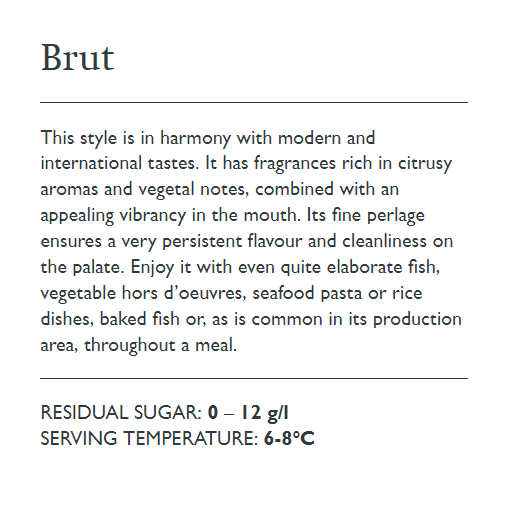
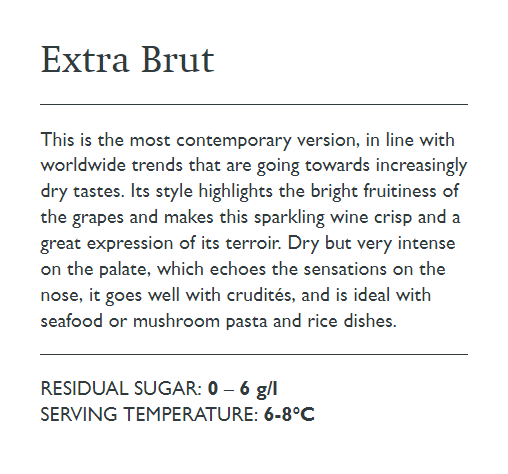
Wine and Food matching
Dining with Prosecco Superiore
Refreshing, versatile and with only moderate alcohol, Conegliano Valdobbiadene is ideal for all sorts of occasions.
It has become famous worldwide as a must at “aperitivo-time”, a ritual that has now become popular at an international level, establishing an iconic moment of the Italian lifestyle. However, thanks to its variable level of sweetness, Prosecco Superiore is also suitable for drinking throughout a meal, particularly in the Brut version.
Serving temperature 6-8° C (42,8 – 46,4° F)
It should always be served “straight” (never mixed) and the secret of matching it with food is succeeding in combining its elegant, non-invasive personality with dishes that show off the quality of the ingredients, thanks to cooking methods that preserve their original flavours and aromas.
Enjoy!
Arrivederci (‘til we meet again)
Mic