Positano was never built for this.
What entropology reveals about the Amalfi Coast's breaking point
Positano
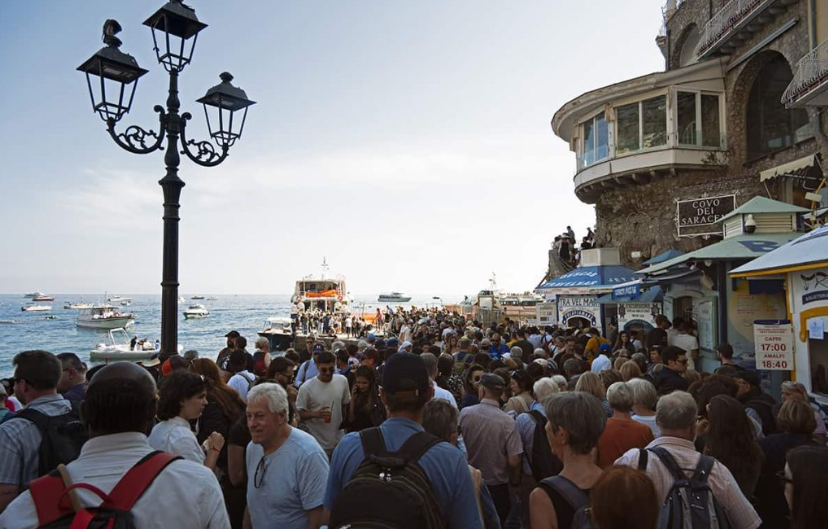
Crowds gather at the ferry boat embarcadero, waiting in lines.
In May 2026, footage from Positano went viral for the wrong reasons. Tourists stood shoulder to shoulder on a cliffside walkway barely wide enough for two people to pass, unable to move in either direction.
Salvatore Gagliano, a hotel owner and former mayor of nearby Praiano, told The Telegraph the scenes were "straight out of the Third World."
"The roads are narrow," he said. "When they are blocked, there is total confusion."
It was not an isolated moment. It was a snapshot of a coastline absorbing far more contact than its geography, built centuries before the automobile, was ever designed to hold.
A Coastline built for a different century
The Amalfi Coast's charm — cliffside villages stacked in pastel tiers, a single winding road threading them together — is also its structural limitation. State Route 163, the road connecting Positano, Amalfi, and Vietri sul Mare, was carved into cliff rock long before anyone imagined the volume of traffic it carries today. Italian road authority ANAS has now introduced an alternating license-plate restriction during peak summer hours on the road's busiest stretch, following a petition signed by more than 10,000 residents. On even-numbered days, cars with even-numbered plates are banned; on odd days, the reverse.
The pressure isn't only vehicular. Researcher Francesca Coppola, who studies overtourism and destination management and returned to her native Sorrento to work on solutions, describes what visitors actually encounter: endless traffic, accommodation in Positano running roughly €500 a night on average, porters charging €15 to carry luggage up a hundred steps, and meals reaching €150 per person. The postcard and the reality have quietly diverged.
"We can't handle so many people. The beauty of the Amalfi Coast is being ruined."
Entropology, Applied to a Cliffside
Claude Lévi-Strauss's concept of entropology — cultural contact as a form of disintegration, an echo of the second law of thermodynamics — was coined about anthropological fieldwork in the Amazon. But it applies with unsettling precision to a place like Positano. The very qualities that draw visitors — narrow lanes, intimate scale, a sense of discovering something not yet overrun — are structurally incompatible with the volume of contact those same qualities now attract. There is no version of mass arrival that leaves a cliffside footpath's intimacy intact.
The human cost compounds the physical one. As Lonely Planet's coverage of the region notes, rents for residents along the Amalfi Coast have climbed so sharply that many people can no longer afford to live near where they work or their children go to school — driven in large part by the higher profit margins short-term holiday rentals offer owners over long-term tenants. Locals in Positano and neighboring Praiano have described feeling, in their own words, trapped in their own streets during peak season.
Slowing the Rate of Contact
Regional leaders have started responding at the scale of the problem. In April 2025, mayors from twenty-five Italian tourist towns — including Capri, Amalfi, and Positano — met for a crisis summit to coordinate an overtourism response. Proposals on the table include limiting cruise-ship arrivals, capping daily passenger volumes the way Venice and Dubrovnik have, and encouraging travel outside the June-through-August peak to spread demand more evenly across the year.
This is precisely where BellaVia's model diverges from the coach-tour default.
We build Amalfi Coast itineraries around small groups, off-peak timing, and a slower pace that doesn't require the road, the footpaths, or the town of Positano itself to absorb more than they can hold.
It means staying two or three nights rather than passing through on a day trip, exploring quieter towns like Vietri sul Mare in daylight and returning to a hillside terrace at dusk, and choosing accommodations and restaurants that keep money circulating through the local economy rather than the cruise-day trade that leaves nothing behind but crowding.
The Amalfi Coast will always draw people who want to see it. The only real variable is how — and how many, and how fast. That is a choice available to every traveler, and it's the one we design around.
Arrivederci
Michael & Simo