Getting sick in Italy during your trip.
If you get sick when you are in Italy. What to do if you find yourself in this situation and you’re not traveling with us?
Hope this never ever happens, but if you get sick while on vacation in Italy, here are a few tips and things you need to know. The Italian healthcare is excellent, but you need to know how it works.
Here are few common mistakes you may avoid if you’re sick or need any medical assistance.
1) THE EMERGENCY ROOM (PRONTO SOCCORSO)
The PRONTO SOCCORSO is the Italian EMERGENCY ROOM, it is for emergencies such as:
Heart attacks, broken bones, stroke symptoms, serious injuries, situations where there is a real life risk.
It is not for stomach aches, food poisoning, sunburn, fever, headache, ear pain, or anything you would normally handle with a pharmacist and a box of medication at home.
Here is why this, matters: the PRONTO SOCCORSO uses a triage system.
When you arrive, a nurse assesses your condition and assigns you a colour code.
That code determines when you are seen — not the time you arrived.
ROSSO (red) — life-threatening. Seen immediately.
VERDE (green) — minor. You wait. One, two, three hours or more depending on the day.
BIANCO (white) — non-urgent. You wait the longest of all.
A stomach problem, mild food poisoning, a fever, a skin rash — these are VERDE or BIANCO. You will sit in that waiting room while people with cardiac events, serious fractures, and trauma go ahead of you. The system is doing exactly what it is supposed to do. You are in the wrong place.
And when you are finally discharged with a white code, you pay a ticket. That is the Italian health system formally confirming that your case did not belong in the emergency room.
2) GO TO THE FARMACIA (PHARMACY).
The FARMACIA is not a DRUGSTORE. The FARMACISTA is a qualified medical professional with a degree in pharmaceutical sciences.
They can assess your condition, ask diagnostic questions, and give you the correct medication for the vast majority of problems tourists actually experience.
Stomach problems, food poisoning symptoms, mild fever, cold and flu, headache, sunburn, insect bites,minor cuts. earache, sore throat, urinary symptoms, skin rashes, mild allergic reaction.
Walk in. Describe the problem. Walk out fifteen minutes later with the right treatment. This costs almost nothing and resolves about 80% of what tourists queue in emergency rooms for.
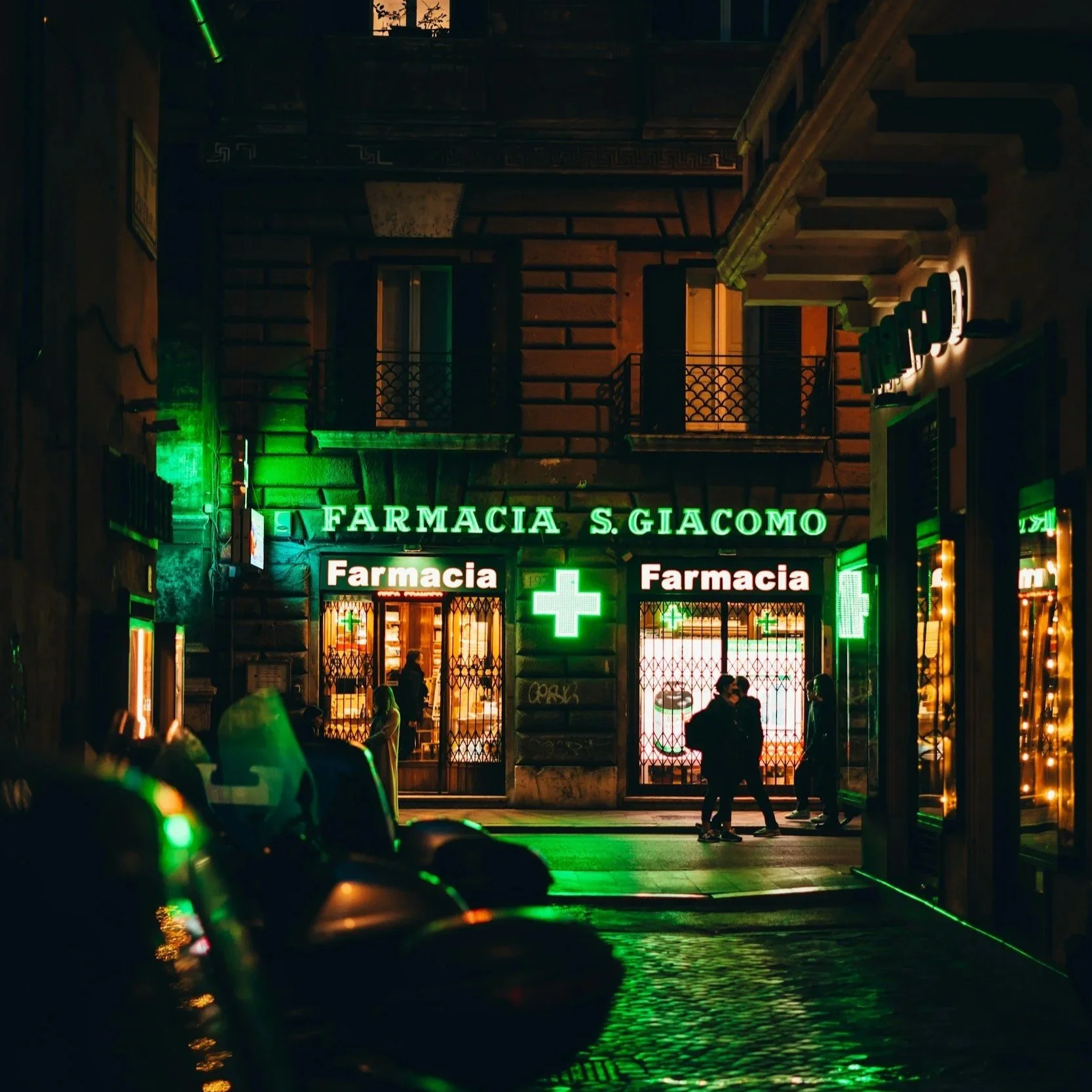
The FARMACIA is marked with a green cross. Every neighbourhood in Italy has one.
3) THE DUTY PHARMACY (FARMACIA DI TURNO)
It is Sunday? It is midnight? The farmacia is closed, you assume there is nowhere to go.
There is always a FARMACIA DI TURNO — A DUTY PHARMACY — open overnight, on Sundays, and on public holidays. The rotation changes weekly. Every closed pharmacy posts the address of the currently open one on its front door. Check the door. Walk or take a taxi to that address. Problem solved.
4) 116117 PHONE NUMBER.
116117 is the official European non-emergency medical number, in Italy it connects you directly to the Guardia Medica — the out-of-hours doctor service.
Call this number when you need an actual doctor but it is not an emergency. Persistent fever, a child who is unwell, an infection that needs a prescription, pain that needs a proper assessment. Anything else you would normally call your GP at home.
Free call. Available 24/7. English-speaking operators - no registration required - no Italian health card needed.
They will assess your situation over the phone, give advice, connect you to a local doctor, or arrange a home visit if necessary. A home visit can cost approximately €25–30. That is the entire cost.
This number is for people who need a doctor but don't need to go to the emergency room.
5) GUARDIA MEDICA TURISTICA
If you are in a major tourist area during peak season — a beach resort, a mountain resort, or a large tourist city in summer — there is often a Guardia Medica Turistica operating specifically for non-residents during daytime hours on weekdays.
This is a public medical service for tourists. A doctor who sees non-residents. No Italian health registration. Approximately €15–20 for a visit. Some require a phone appointment, others take walk-ins.
Ask your hotel reception, ask the tourist office, or call 116117 and they will tell you if one is active in the area you’re staying.
6) SAVE THESE PHONE NUMBERS
112 — European emergency number. Works across the entire EU. Police, fire, medical. If you are not sure which service you need, call this first. They will direct you.
118 — Italian ambulance directly. Use this if you know you need an ambulance immediately.
116117 — Non-emergency medical assistance. Free, 24 hours, English-speaking. Everything that is not an emergency but needs a doctor. This is the number you will actually use.
7) TRAVEL INSURANCE IS NOT OPTIONAL.
Non-EU visitors — Americans, Canadians, Australians, and others (non- reciprocal health systems) — pay out of pocket for medical services in Italy unless covered by travel insurance.
A PRONTO SOCCORSO visit for life threatening emergency may be free, but prescriptions, follow-up care, and non-emergency visits will have costs.
Travel insurance with medical coverage is not an option, it is VERY important.
8) GUIDELINES:
Something minor — stomach, fever, sunburn, insect bite, headache, sore throat, mild food poisoning → go to FARMACIA.
NEEDS A DOCTOR, NOT AN EMERGENCY → call 116117. GUARDIA MEDICA. GUARDIA MEDICA TURISTICA if available in your area.
Chest pain, breathing difficulty, suspected stroke, serious injury, life threatening emergency → call 112 or 118. PRONTO SOCCORSO, immediately.
Save this before you travel.
Buon viaggio!
Mic e Simo